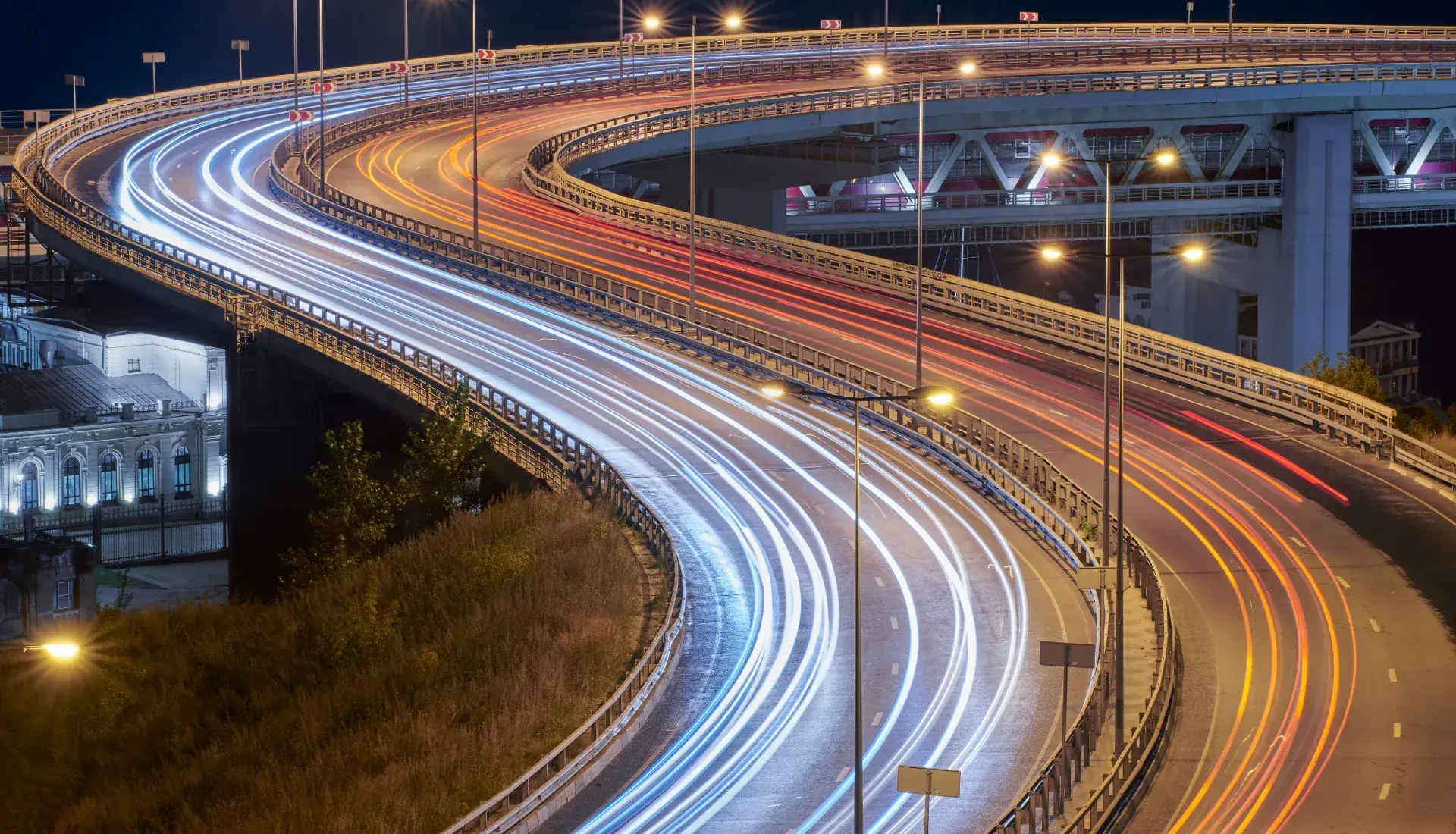
Ask anyone who bought a flat in New Gurgaon around 2015 what the Dwarka Expressway meant to them, and you'll probably get a sigh first.
For years, it was the road that was always "almost done". Glossy brochures showed it as a finished eight-lane boulevard. On the ground, there were half-built flyovers, dust, diversions and a lot of patience. People bought homes facing a highway that didn't quite exist yet.
Fast forward to today, and the picture has flipped. The expressway is fully open. Cars glide from Gurgaon's new sectors toward the airport without a single signal. And the land on either side has turned into some of the most sought-after real estate in the National Capital Region.
So what actually happened? How did a delayed bypass become the X-factor in Gurgaon's growth story? And if you're thinking of buying here, what should you really know?
Let's take it slowly, one piece at a time.
A road years in the making
Where it started
The Dwarka Expressway began life on Gurgaon's master plan as the Northern Peripheral Road, or NPR. The idea was simple. NH-48, the old Delhi–Gurgaon highway, was choking. It was carrying more than three lakh passenger car units a day, far beyond its design. Gurgaon needed a second artery.
The early plan was a modest bypass. What eventually got built, under the Centre's Bharatmala programme, was something much bigger.
What got built
Today's expressway runs about 29 km, from Shiv Murti near Mahipalpur in Delhi to Kherki Daula on NH-48 in Gurgaon. Roughly 19 km sits in Haryana and about 10.1 km in Delhi. Along the way it passes Dwarka Sector 21, crosses the Delhi–Haryana border and runs past Basai before rejoining NH-48.
It's an eight-lane, access-controlled main road with service roads on both sides. That's why you'll often hear it called a 16-lane corridor.
The engineering, in plain words
This is where the expressway earns its "first in India" tag.
- An eight-lane flyover on a single row of pillars. About 9 km of the road is elevated, 34 metres wide, sitting on one line of pillars. No Indian city road had done that before. It keeps the ground below free for service roads, so local and through traffic don't collide.
- India's longest and widest urban road tunnel. About 3.6 km long and eight lanes wide, connecting the corridor toward IGI Airport.
- Four levels of road in places. A tunnel at the bottom, the ground road, an elevated flyover, and another flyover above that.
- Serious scale. Around 2 lakh tonnes of steel, roughly 30 times what went into the Eiffel Tower, and about 20 lakh cubic metres of concrete, around six times the Burj Khalifa.
You don't need to be an engineer to feel the difference. You just drive it.
The wait, and the finish line
We'd be lying if we said it was smooth. Deadlines came and went, and the Delhi end was held up for a long time by tunnel works near the airport.
Then the finish line arrived in two steps. The Prime Minister opened the 19 km Haryana section in March 2024. The 10.1 km Delhi section, built at around ₹5,360 crore, followed on 17 August 2025. For the first time, the whole corridor was open end to end.
That date matters for anyone buying here. Before it, you were betting on a promise. After it, you're buying into something that works.
Connected to everything
Here's a thought experiment. Picture a map of Delhi-NCR and draw lines for the airport, the national highways, Delhi's new outer ring road and the metro. Now look at where those lines meet. A surprising number of them meet on or near Dwarka Expressway.
The airport, right next door
The Delhi end of the corridor connects to the airport side through the tunnel and the Shiv Murti interchange. From most of the residential sectors, IGI Airport is now a short drive, with no signals and no NH-48 gamble. For frequent flyers, NRIs and anyone in aviation or hospitality, that alone is a big deal.
NH-48 at both ends
The expressway leaves NH-48 at Shiv Murti and rejoins it at Kherki Daula. Think of it as a parallel highway. On a bad day at Rajokri or Sirhaul, it's your way around.
UER-II: Delhi's new outer ring
The Delhi section plugs straight into Urban Extension Road-II, which opened the same day in August 2025. UER-II is a roughly 76 km, six-lane road that sweeps toward Najafgarh, Mundka, Rohini and Alipur, with links toward Bahadurgarh and Sonipat. It also connects toward the roads heading to Chandigarh, Rohtak and beyond.
In practical terms, north and west Delhi suddenly feel a lot closer. Government estimates put the cut in travel time between the airport and parts of south-west and north-west Delhi at 40 to 60 per cent.
South to Sohna, KMP and the Delhi–Mumbai Expressway
At the Gurgaon end, the corridor feeds into NH-48 and the Southern Peripheral Road. From there, you're on your way to Sohna, the KMP Expressway and the Delhi–Mumbai Expressway.
Metro on both sides
On the Delhi side, the Blue Line and the Airport Express (Orange) Line both reach Dwarka Sector 21. The Airport Express now runs one stop further, to Yashobhoomi Dwarka Sector 25, right at the mouth of the expressway.
On the Gurgaon side, the new Gurugram Metro is the one to watch. Approved by the Union Cabinet in June 2023 at about ₹5,452 crore, it runs from Millennium City Centre through Sectors 45–47, Subhash Chowk, Hero Honda Chowk, Sector 10, Sector 37 and Basai. A 1.85 km spur from Basai will bring a station to Sector 101, directly on the expressway. Phase 1 construction is underway, with the first stretch targeted for around mid-2027.
There's also a proposed link from Palam Vihar to Dwarka Sector 21, which would tie Gurgaon's metro to Delhi's Blue Line. As with every metro project, we'd treat the dates as targets. But the trains are clearly coming.
Rail, too
Bijwasan railway station, beside Dwarka Sector 21, is being rebuilt into a modern rail terminal tied into the expressway's Delhi section. More on that in a moment.
From Global City to Yashobhoomi
Most corridors in India are lucky to have one big anchor. Dwarka Expressway has one at each end, and several in between. Let's drive it from south to north.
Stop 1: Global City, Gurgaon
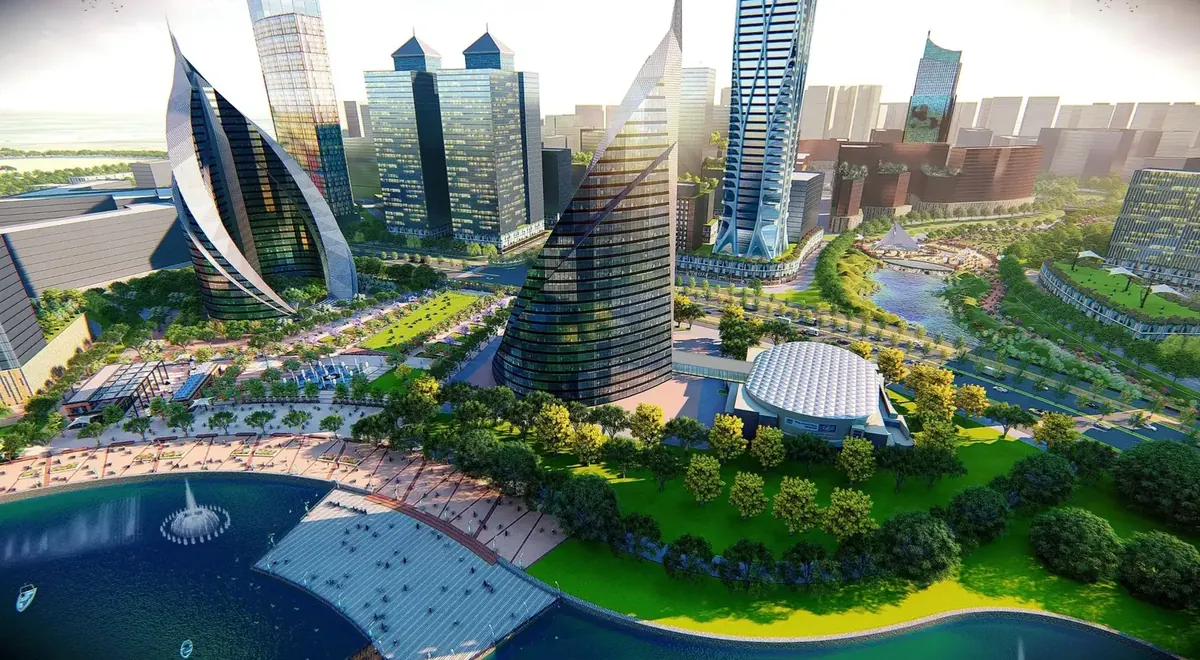
Near the Kherki Daula end, across Sectors 36, 36B, 37, 37A and 37B, the Haryana government is building Global City. It's a planned business and residential township of roughly 1,000 acres, developed by the state's industrial agency, HSIIDC.
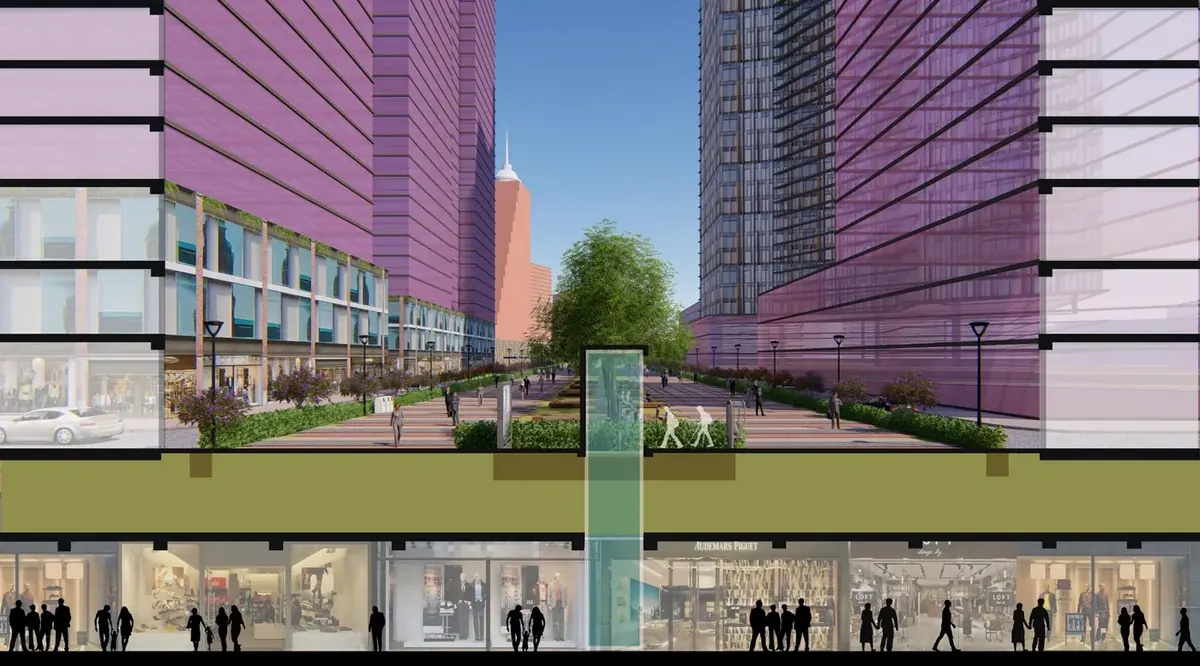
The interesting part isn't the size. It's the approach. Most of Gurgaon grew the other way round: builders put up towers first, and roads, drains and water caught up later, if at all. Global City reverses that. The government lays the infrastructure first, then private construction follows.
Here's where it stands:
- Phase 1 covers about 587 acres, with a roughly ₹940 crore infrastructure contract awarded in 2023 and a completion target of December 2026.
- Environmental clearance came through in 2024.
- The plan mixes office towers, homes, retail, hotels, hospitals and schools, plus walking and cycling paths, a water treatment plant and a green lake.
- Leading developers, including DLF, M3M, Godrej, Sobha and Signature Global, have shown interest in or acquired parcels through HSIIDC's auctions.
- Officials have pitched an investment potential of around ₹1 lakh crore and describe it as Gurgaon's next economic engine after Cyber City.
Why does this matter for homes on the corridor? Because jobs create housing demand. Cyber City is what turned DLF Phases and Golf Course Road into premium addresses. A working Global City could do the same for the sectors around it.
Stop 2: A transport node at Kherki Daula
Gurgaon–Manesar's Master Plan 2031 proposes an inter-state bus terminal at Kherki Daula, right where the expressway meets NH-48. It's still a proposal, but it shows how planners see this junction: as a hub, not just a toll plaza.
Stop 3: The metro at Sector 101
Heading north, Sector 101 is where the Gurugram Metro's Basai spur will land. It will be the first metro station built specifically for the expressway's residential belt.
Stop 4: Bijwasan, an airport-style railway station
Cross into Delhi and you reach Bijwasan station, next to Dwarka Sector 21. It's being rebuilt from a small local stop into a proper terminal: eight platforms instead of two, separate arrival and departure areas, and a concourse above the tracks, much like an airport. Major structural work is reported complete and finishing work is in progress.
Stop 5: Delhi's second Diplomatic Enclave
Chanakyapuri has been Delhi's embassy district for decades. The second one is planned in Dwarka Sector 24, where the Union Cabinet approved transferring about 34.87 hectares for embassies and international organisations. It's a quiet detail with a loud signal: this part of the city is being planned for an international audience.
Stop 6: Yashobhoomi
And then you arrive at Yashobhoomi, the India International Convention & Expo Centre in Dwarka Sector 25.
The Prime Minister opened Phase 1 on 17 September 2023, built at around ₹5,400 crore. It's genuinely huge:
- A total project area of over 8.9 lakh sq metres, with more than 1.8 lakh sq metres built up.
- A convention centre with 15 halls and rooms, able to host about 11,000 delegates at once.
- A plenary hall seating around 6,000, wrapped in what's billed as India's largest LED media facade.
- Large exhibition halls and green credentials such as rooftop solar and full wastewater reuse.
- Its own Airport Express metro station, about 3 km from IGI Airport.
Phase 2 is where the real estate story gets exciting. Plans include more exhibition halls, around 3,500 hotel rooms and about 4.5 million sq ft of offices and retail, with the government aiming to attract roughly ₹20,000 crore of private investment.
Global conferences bring business travellers, executives and companies who want to be nearby. And Yashobhoomi sits right at the Delhi gateway of Dwarka Expressway.
The big picture
Put it all together and you get a business city at one end, a world-scale convention district at the other, and an airport, a railway hub, a diplomatic enclave and two metro systems in between. That's not one reason to grow. It's half a dozen, lined up along one road.
What it has done to real estate
From "too far" to "too good to ignore"
Not long ago, the standard objection to Dwarka Expressway was distance. It felt like the edge of Gurgaon. Today it's where most of the city's new luxury homes are being launched.
The numbers tell that story clearly. According to ANAROCK's September 2026 report, average home prices along the corridor rose from about ₹6,032 per sq ft in 2021 to about ₹14,180 per sq ft in H1 2026. That's an increase of roughly 135% in five years. Over the same stretch, around 38,680 new homes were launched here.
And here's the line we find most telling: the corridor's average is now higher than Gurgaon's overall average of about ₹13,350 per sq ft. The "budget alternative" has become a premium market.
Other research points the same way. Square Yards recorded about 29% price growth in 2024 alone, and says new supply has crossed 10,000 units a year since the pandemic, up from 5,000–7,000 before it. Industry reports also put projects approved along the corridor in 2025 at over ₹86,588 crore.
One honest caveat. Different firms measure differently, and fresh luxury launches often price well above the corridor average. So when you compare, compare like with like.
The names on the skyline
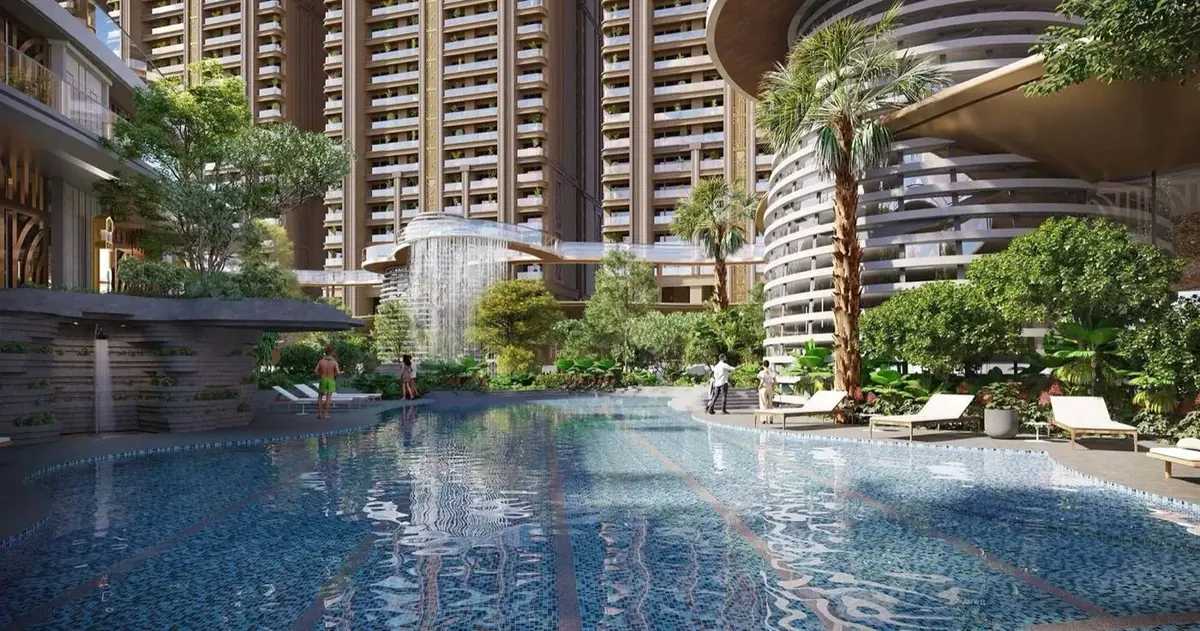
Almost every serious developer in India now has a stake here: DLF, Godrej, Sobha, M3M, Signature Global, Elan, Adani, Tata, Experion, Hero Homes, Smartworld, Whiteland, Max Estates and Emaar, among others.
A few projects show how far the corridor has come:
- Westin Residences by Whiteland (Sector 103), branded residences in partnership with Marriott. When a global hotel brand puts its name on homes here, it tells you how the address is now seen.
- Godrej Vrikshya (Sector 103) and Adani The Marq (Sector 102), large-format homes right on the expressway.
- The Palatial by Hero Homes (Sector 104), a palace-inspired luxury project near Conscient One mall.
- Sobha Altus (Sector 106), Sobha's latest on the corridor.
- M3M Crown (Sector 111) and M3M Capital and M3M Mansion (Sector 113) near the Delhi end.
- Smartworld One DXP (Sector 113), right at the Delhi gateway.
- Experion Windchants (Sector 112) and Tata La Vida (Sector 113), for buyers who want ready homes.
- Godrej Air (Sector 85), one of the earlier delivered projects on the southern stretch.
- Max Estates (Sector 36A), close to Global City.
We mention these to show the calibre of the market, not as blanket recommendations. Each one deserves its own homework.
Reading the corridor, sector by sector
It helps to think of the corridor in four stretches:
- Sectors 108–113. Closest to Delhi, Dwarka and the airport. A dense mix of ready and new luxury projects. Ideal if you fly often or work in Delhi.
- Sectors 99–106. The heart of the corridor, where many of the newest branded launches are. Suited to long-term luxury living and premium investment.
- Sectors 81–90. The earliest-developed stretch, with more delivered homes and a settled, lived-in feel.
- Sectors 36A–37D. Near Kherki Daula, NH-48 and Global City. The place to look if you're betting on the Global City job story.
Life on the corridor
A great road and rising prices are nice. But you don't live in a price chart. You live in a neighbourhood.
That's the quieter change on Dwarka Expressway. A few years ago, many towers stood in empty fields, and a carton of milk meant a drive. Today, the corridor has malls like Conscient One, schools, hospitals and everyday shops filling in around the housing. Families have moved in. Weekend traffic now includes cycling groups and evening walkers, not just construction trucks.
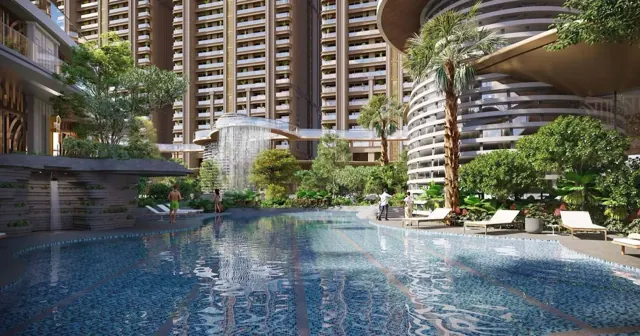
The homes themselves are part of the appeal too. Many newer projects offer larger floor plans, low-density layouts and the kind of clubhouses and green spaces that are hard to find in older Gurgaon.
Is it perfect? No neighbourhood in NCR is. Some pockets are still filling in, and social infrastructure is catching up with the pace of construction. But the direction is unmistakable. The corridor is crossing the line from investment zone to real neighbourhood.
Is it still a good time to buy?
This is the question we hear most: "Have I missed the bus?"
Here's our honest take. The early, speculative phase is over. Buying here a decade ago was a bet on a road that might never arrive. That risk is gone, and so are the bargain prices that came with it.
What you get instead is something most buyers should prefer: certainty. The road is real, it works, and you can drive it before you sign anything.
And several of the corridor's biggest growth drivers are still to fully play out:
- Global City is only finishing its first phase of infrastructure. Offices and jobs come next.
- The Gurugram Metro spur to Sector 101 is still under construction.
- Yashobhoomi Phase 2, with hotels, offices and retail, is still ahead.
- Bijwasan station is in its finishing stages.
- The second Diplomatic Enclave in Dwarka Sector 24 is still taking shape.
In short, the road is done, but much of what the road unlocks is still being built.
Five things we tell every client
- Choose your end of the corridor. If you're often in Delhi or at the airport, look at Sectors 108–113. If Global City and NH-48 matter more, look south.
- Go beyond the brochure. Check RERA registration, the developer's delivery record and the real distance to the expressway.
- Match the purchase to your timeline. The infrastructure here unfolds over years, not months. Plan your holding period accordingly.
- Weigh ready against under-construction. Ready homes cost more per sq ft but remove delivery risk. New launches offer payment flexibility and newer specifications.
- Get local advice. Prices can vary widely even inside one sector. A conversation with someone who knows the ground can save you a lot.
Frequently asked questions
How long is Dwarka Expressway? About 29 km, from Shiv Murti in Delhi to Kherki Daula on NH-48 in Gurgaon. Roughly 19 km is in Haryana and about 10.1 km in Delhi.
Is the whole expressway open? Yes. The Haryana section opened in March 2024 and the Delhi section on 17 August 2025.
How close is it to IGI Airport? Very close. The Delhi end connects to the airport side through a tunnel and the Shiv Murti interchange, making it a short, signal-free drive from most sectors.
Is there a metro on Dwarka Expressway? On the Delhi side, yes: the Blue Line and Airport Express serve Dwarka Sector 21, and the Airport Express reaches Yashobhoomi at Sector 25. On the Gurgaon side, a Gurugram Metro spur with a station at Sector 101 is under construction.
What is Global City? A roughly 1,000-acre planned business and residential township being built by HSIIDC in Sectors 36–37B, near the Kherki Daula end of the expressway.
What is Yashobhoomi? The India International Convention & Expo Centre in Dwarka Sector 25, one of the world's largest venues of its kind, at the Delhi end of the corridor.
How much have prices grown? According to ANAROCK, average prices rose from about ₹6,032 per sq ft in 2021 to about ₹14,180 per sq ft in H1 2026, roughly 135%.
Which sectors are best? It depends on your priorities. Sectors 108–113 suit Delhi and airport access. Sectors 99–106 hold many new luxury launches. Sectors 81–90 are more established. Sectors 36A–37D sit close to Global City.
The bottom line
Gurgaon has grown in waves. The first came with NH-48 and Cyber City. The second came with Golf Course Road and Golf Course Extension. The third is happening right now, along Dwarka Expressway.
What makes this wave different is how much is built into it from day one: an international airport, a world-scale convention city, a diplomatic enclave, metro and rail links, and a brand-new business district. No earlier Gurgaon corridor started with that kind of foundation.
That's why we call it the X-factor. It isn't just another road. It's the road the rest of the region is now being built around.
If you're thinking about a home or an investment here, let's talk. We'll help you find the stretch of the corridor that fits your plans.
Sources
- PM India: Delhi section of Dwarka Expressway and UER-II
- Tribune: Delhi section cost
- India Infra Hub: engineering facts
- Latestly: travel times and UER-II
- Tribune: Gurugram Metro and Sector 101 spur
- ThePrint: Global City
- Construction World: Global City developers
- India Infra Hub: Yashobhoomi Phase 1
- Biltrax: Yashobhoomi Phase 2
- PM India: second Diplomatic Enclave
- Outlook Money: ANAROCK price data
- Square Yards: price growth and supply
- #DwarkaExpressway
- #GlobalCity
- #Yashobhoomi
- #GurugramMetro
- #GurgaonRealEstate